Playing a Violin Changes the Player Before the Wood
A violin's measured resonances are set by geometry, mass and stiffness. What players call break-in lives in bridge feet, humidity cycles and strings, which is a different claim.
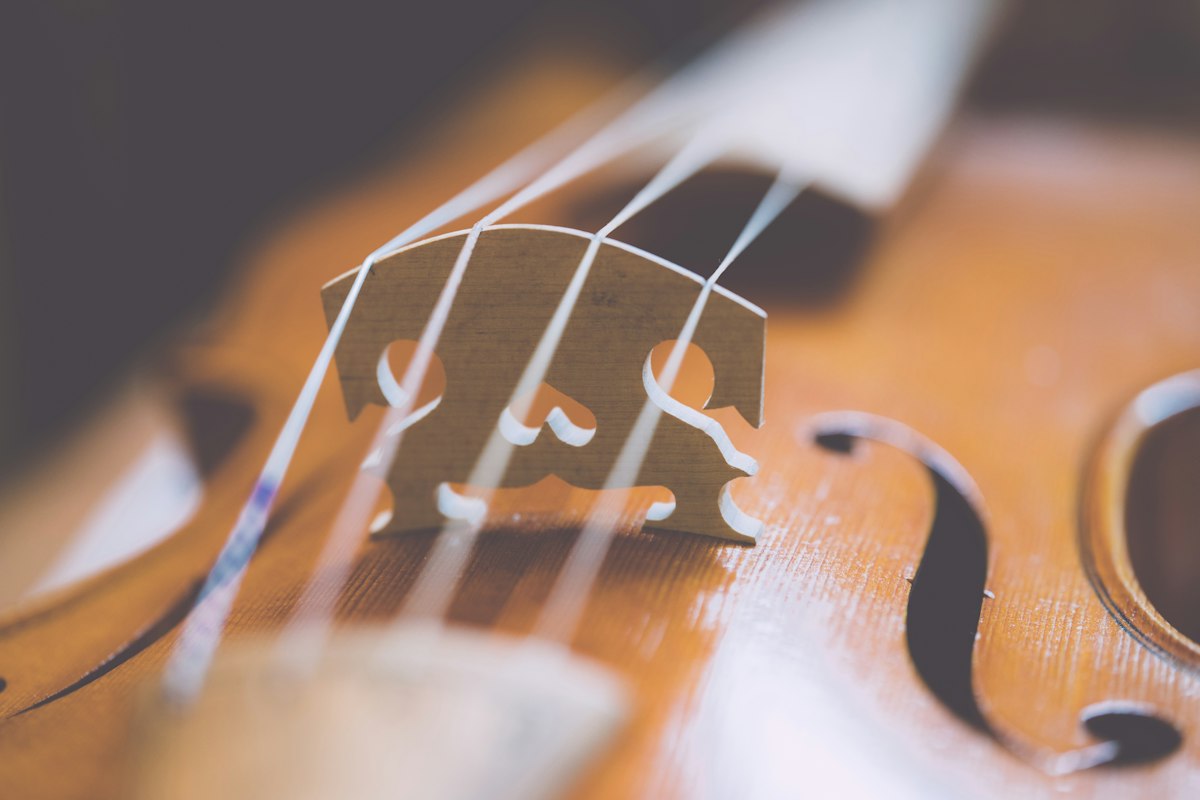
The mark the bridge leaves
The bridge of a violin is not glued. It stands on the top plate, held down only by string pressure. After a season of regular playing, its feet leave pale outlines where the varnish has been burnished thin. That mark is real, and it is the honest boundary of what playing does to an instrument.
Playing a violin changes it, but the change that matters sits outside the plates. The measurable architecture of an instrument, its set of resonant modes, is fixed by geometry, mass and stiffness, and none of those move much under a bow. What does move is seating, moisture, string age and the player's own hands. A violin sounds better after long use for reasons that have almost nothing to do with the wood.
What sets a violin's resonances
A violin works as a pair of coupled systems. The strings supply a family of pitches. The body answers with its own resonances, and makers have tapped those frequencies out and listened to them. Those peaks follow the shape, thickness and density of the plates. A player cannot change any of that by practice.
None of that is negotiable by playing. A violin has no mechanism for thinning a plate where a player would like it thinner, and no mechanism for moving a bass bar. Bending the top plate by hand changes its note; releasing the bend restores it, because spruce behaves elastically at the stresses a bow produces. So the break-in story has to live somewhere other than the plates.
The mechanisms people actually invoke
Wood is viscoelastic, which means it does not spring back instantly. Every vibration dumps a little energy as heat inside the fibers, and how much is lost depends on how wet those fibers are. A violin played daily runs slightly warm under the chin and cools in the case. That cycle is a real physical event, and it is the most defensible basis for the idea that playing changes the sound.
The second candidate is mechanical rather than material. Bridge feet, soundpost tips, the nut and the fingerboard are all contact points, and contact points polish. A high spot on a bridge foot carries load until it flattens, and the flattening changes how vibration crosses into the plate. That process is genuine, it finishes early, and it is a fitting problem more than a wood problem.
The confound that eats the evidence
Players report that an instrument improves, and they are reporting something real. Most of what they are describing is their own competence. A violin rewards the hours spent on it. Bow control, intonation and pressure all drift upward under the same instrument, and the ear credits the wood for what the right arm learned. That attribution is the quiet failure inside almost every anecdote about break-in.
Reports are not measurements.
There is a second leak. A player who believes an instrument has improved plays it differently, with more commitment and a faster bow, and the sound really does change in the room. The only clean design is a blind comparison: same player, same room, same microphone, against an instrument stored unused in the same cupboard. That control is expensive and rare.
The strongest case for the other side
The skeptical version above is too tidy, and the fair counter-argument starts from a simple fact: a violin is not a sealed object. It exchanges moisture with a heated room in winter and a humid hall in summer, and the top plate swells and shrinks as it does. Cyclic drying can relax stress in a plate that was bent into shape by a hot iron during construction. A plate that relaxes is a plate whose stiffness has changed.
That is the version of the claim worth defending: slow climate cycling happening alongside playing, not playing alone. It also explains why the effect is reported mostly in older instruments, and mostly by people who inherited them. Under this reading, a violin played daily in a stable room should change less than one that lives on a shoulder in a damp city. This desk has nothing to weigh on either side.
What the available record does not say
The phys.org item of late November poses a question. This desk could not read the work behind it, and that distinction matters, because a question about wood arrives at the reader as a finding. Without the method there is no sample size, no control instrument, no measurement type and no listening protocol to check.
What can be done here is narrower: set the burden of proof and show where it is heavy. Improved physical characteristics is a measurable phrase. It should mean a shift in resonant frequency, a change in damping, or a documented rise in radiated power. Any of those would be falsifiable, and any of them is cheap to run on an instrument sitting in a hallway.
What changes quickly, and what barely moves
Strings dominate. A new string is brighter than a worn one, and swapping it resets an instrument more thoroughly than a long season of practice does. Below strings sits setup: bridge mass and cut, soundpost placement, tailpiece, the state of the nut slots. Only under those layers does the wood matter, and it moves slowly, in a dry house, over decades rather than weekends.
That ordering has an unglamorous consequence for anyone buying an old instrument on the strength of its mileage. A violin that lived in one house, played daily and stored flat has had its contact points settled for a long time. Settling is not permanent. A fresh bridge, a new soundpost fit and a change of strings erase most of what the previous owner's years bought. What the buyer is paying for is geometry, and geometry was in the room on the first day.
The test that would settle it
The test costs an afternoon and a phone. Pick the instrument already owned. Change nothing else: same bow, same strings, same room, same microphone. Choose a passage that keeps the left hand as still as possible. Record it now, then record it again after a stretch of daily playing, and keep the files rather than the impression.
Blindness is the part no player manages alone, and it is the part that decides the outcome. A shift that survives fresh strings on both instruments, a listener who cannot see the fiddles, and a week between takes says something about wood. Anything weaker says something about practice, which is not a complaint. A lot of the money in this trade goes to the second thing while everyone talks about the first.